Transforming Care: The Metamorphosis of Las Vegas Trail Neighborhood Health Center
Located on a mile-long corridor south of I-30 and east of Loop 820 in west Fort Worth, Las Vegas Trail (LVT) is a community steeped in history. The area thrived during the mid-20th century, housing workers from Lockheed Martin and the Naval Air Station Joint Reserve Base. However, over time, it faced challenges – for more than three decades, LVT has struggled with limited healthcare access, effectively becoming a “health care desert.” In 2021 alone, LVT residents made more than 4,000 visits to Cook Children’s emergency or urgent care centers for primary care needs, underscoring the lack of nearby providers, according to a press release.
That changed in late 2025 with the opening of the Las Vegas Trail Neighborhood Health Center, a collaborative development led by Cook Children’s, JPS Health Network, and the City of Fort Worth. The new 40,000-square-foot center now brings pediatric care (Cook Children’s), adult care (JPS), behavioral health, social services, food pantry, and education space, in addition to a neighborhood police substation directly into the heart of the community.
Dunaway is proud to continue our longstanding partnership with Cook Children’s and JPS, teaming with Oculus, Inc. to deliver civil and structural engineering, planning + landscape architecture, environmental, and surveying services for this much-needed community resource.
The Butterfly Effect
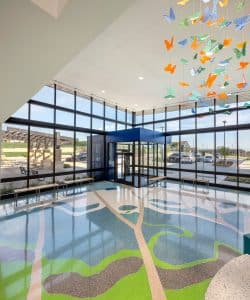
A unifying butterfly theme flows throughout the center, symbolizing growth, renewal, and the community’s ongoing metamorphosis. Selected both for its metaphorical resonance and for the monarch migration route that passes through North Texas, the butterfly motif appears throughout the site and within the building – creating a cohesive narrative that ties together landscape, architecture, and community identity.
Dunaway’s Planning + Landscape Architecture team worked closely with Oculus to weave the butterfly theme into the user experience through thoughtful site design and playful, interpretive outdoor spaces. Visitors are greeted at the main entry by a decorative plaza with pavers, planter pots, outdoor seating, and butterfly-patterned pavement stamps.
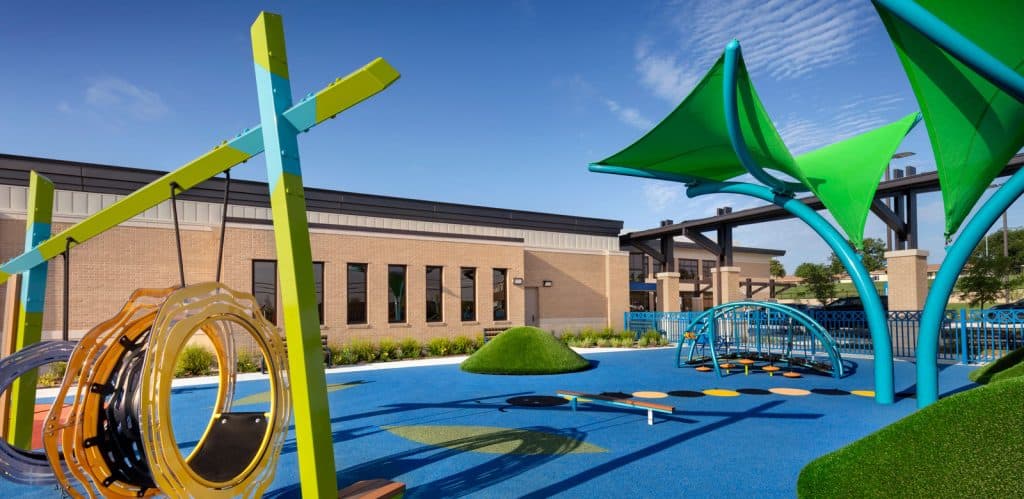
Across the site, shade structures resemble butterfly wings, and play surfacing incorporates caterpillar and butterfly graphics – guiding children through the stages of transformation. To support monarch migration, the planting design emphasizes native pollinator species, including Texas lantana, Turk’s cap, autumn sage, and black-eyed Susan, creating habitat and seasonal color year-round.
As Hannah Rohlfing, Senior Interior Designer with Oculus, noted, “Collaborating with Dunaway to coordinate the butterfly design concept of the facility within their work was seamless and effective. The accomplishment of their design work was evident in the final solution that brought the site to life through their use of color, imagery, and playground equipment that highlight a vibrant spot for the community.”
Collaborating with Dunaway to coordinate the butterfly design concept was seamless and effective. The accomplishment of their design work was evident in the final solution that brought the site to life through their use of color, imagery, and playground equipment that highlight a vibrant spot for the community.
”Safety, Access, and Aesthetics
Designing the site’s civil infrastructure required careful planning and innovative approaches, particularly when overcoming grading and stormwater challenges. Significant grade challenges on the 3.7-acre site were resolved through a series of large retaining walls, which were integrated into both the site circulation and now double as a vibrant community mural space painted by neighborhood residents – further reinforcing the feeling of uplift and empowerment.
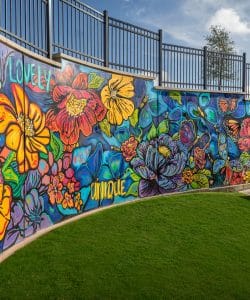
Pictured: Mural by artist Calina “Cal” Mishay Mejia
To maintain a safe, child-focused site aesthetic, Dunaway’s civil engineers designed an underground detention system, chosen to avoid above-ground water features for safety, aesthetic purposes, and to maximize site/lot area for the development while ensuring efficient drainage. The team also added public sidewalks and pedestrian pathways through the site, enhancing community access and providing various access options.
Because the center houses pediatric, adult care, behavioral health, and social services, the design team carefully coordinated multiple access points, providing intuitive circulation for patients, staff, and public safety representatives. Visible above-ground utilities and infrastructure were also sited with equal intention – positioned to avoid obstructing signage, entry views, or thematic elements.
Stability Beneath the Surface
Challenging soil conditions also require innovative structural solutions. Dunaway designed a suspended structural foundation to provide long-term stability and performance. Architecturally exposed large tube-steel canopies encircle the building, further enhancing the center’s visual identity. Retaining walls – engineered in coordination with Dunaway’s Civil and PLA teams – support the site’s major grade transitions, reinforcing the architectural expression, and providing a durable canvas for the community mural.
Dunaway’s ability to deliver survey, environmental, landscape architecture, civil engineering, and structural engineering under one roof played a vital role in the project’s success. “Working with the Dunaway team was seamless and without hiccups,” recalled Matthew Thole, Senior Project Designer with Oculus. “We were able to lean on their expertise and specific familiarity with the local jurisdiction to solve issues specific to the site planting requirement, miscellaneous structural field solutions, and project work/improvements within the surrounding public right-of-way, quickly and without encumbering the project schedule or other members of the project team.” This integration ensured that the health center’s technical requirements, community-focused features, and symbolic design elements worked in harmony.
The Metamorphosis of a Community
Just like a butterfly, the Las Vegas Trail (LVT) community has emerged into a harmonious place where families can access care, support services, and community resources close to home. From site design and grading to structural systems and a rich visual narrative, we are proud to play a role in helping the LVT Neighborhood Health Center take flight, shaping a space that embodies resilience, dignity, and transformation for those who need it most.
Ready to Transform Your Community Space?
When working with Dunaway, you are limited only by your imagination. From master planning to infrastructure, amenity spaces, and project delivery, our team has experience on a range of healthcare projects uniquely customized for the patients, employees, and communities they serve. We invite you to experience the difference that our multidisciplinary approach can make.
About the Authors