The Journey from EIT to PE
The Journey From EIT to PE
In honor of “Engineers Week,” all of us at Dunaway are proud to share in the accomplishment that, after years of hard work and dedication, several of our engineers-in-training have earned their professional engineering licenses! We asked them what it was like to go from engineer-in-training to professional engineer, and what is involved in the process.
Why did you choose this career?
“I wanted to have a career that would allow me to constantly grow and progress, both personally and professionally. I also think mentorship and leadership are very important; this career helps you learn how to be both a good listener and a good leader.”– Anna Kallergis, PE
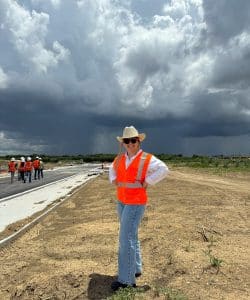
Pictured: Sarah Guy, PE at a site visit.
“I chose civil engineering because it’s a cool mix of logic and geometrics – like a puzzle – and I wanted my daily work to contribute to my communities. I love helping make neighborhoods more connected, safe, and accessible for everyone.”– Sarah Guy, PE
“Stability! As long as we have society, we’ll be building and having infrastructure, and my skill set will always be needed.” – Bekah Baker, PE
“I originally had an interest in architecture, and I really liked math and science in school, so structural engineering seemed like the perfect mix of those interests. Additionally, having a tangible impact on society through the structures I help design—and getting to see them constructed and occupied—is extremely rewarding.” – Daniella Toledo, PE
“I’ve always really enjoyed buildings and construction. When I was deciding what college to attend and choosing my major, I was stuck between architecture and civil engineering. I decided that my math skills were better than my drawing skills, so I went with civil engineering.” – Faith Butts, PE
“I chose engineering because I’ve always enjoyed problem-solving and figuring out how things work in the real world. Civil engineering, specifically, appealed to me because it involves designing projects that people use every day, such as roads, drainage systems, neighborhoods, and infrastructure that directly impact communities. As I got further into my career, I gravitated toward water resources because I enjoy the design and analysis behind stormwater management.” – Justin Box, PE
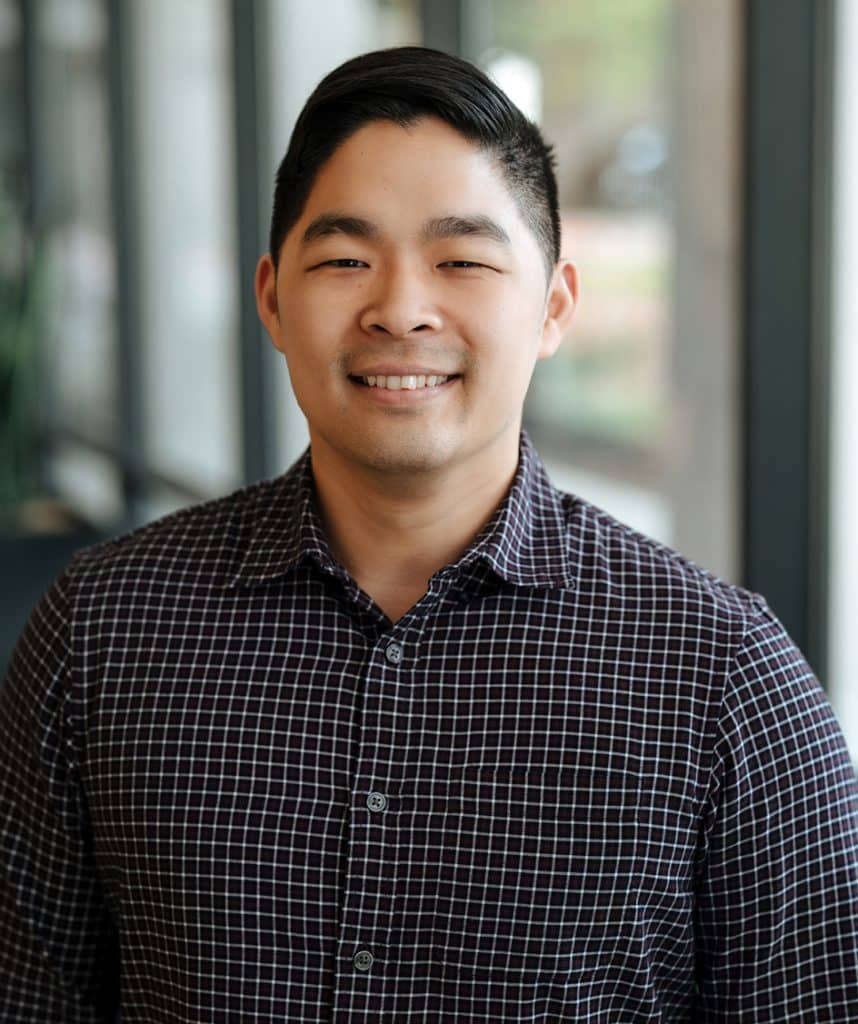
“I chose this career because I want to help improve our communities.” – John Chiang, PE
What steps did you have to take to get your PE license? What was the hardest part?
“I took an online prep class Mon-Thurs for 8 weeks during the summer. And then I took at least one practice test every two weeks on Saturdays or Sundays. The hardest part was maintaining self-discipline, staying inside and studying, and not giving in to peer pressure during the summer.” – Anna Kallergis, PE
“The hardest part was perseverance. I failed my first two attempts at the PE. During both of those attempts, it was a difficult time in my personal life, so my confidence was crushed. Fortunately, I had support from my close friends, family, and my teammates, who all encouraged me to keep trying. Once I found the study materials and flow that worked for me, I got back into the testing room and ended up crushing it! Fall down two times, get up three.” – Sarah Guy, PE
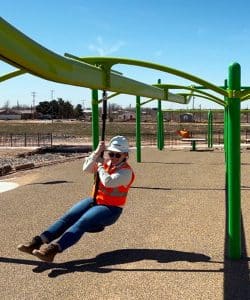
Bekah Baker, PE, testing the zip line at Martin County Community Complex.
“I took the PE once and failed, and gained some more experience, buckled down and took the PE again to pass. The hardest part was dedicating time to studying enough. I wanted to be comfortable with the material so I could be confident when I went in to retake the test.” – Bekah Baker, PE
“The hardest part was taking the PE exam. The sheer number of hours required to study outside of work, along with finding a good balance between work, life, and studying, was challenging.” – Daniella Toledo, PE
“The exams were demanding (I had to take the PE exam twice), but getting my degree was the hardest part of becoming a licensed engineer. I was a commuter and worked part-time to afford college classes. With the addition of online classes due to COVID-19, it was a challenge to continue to see the goal at the end of it all as worthwhile. I am grateful that I persevered to get my PE licensure.” – Faith Butts, PE
“The hardest part was studying, working a full-time job, and balancing family life at home. After a full workday, the last thing you want to do is open a review book, but staying consistent is what makes the difference.” – Justin Box, PE
“The license required a lot of studying and learning on the job. The hardest part was preparing for the exam while working a full-time job. Time management is key.” – John Chiang, PE
The challenging nature of the work keeps the job exciting. I love that I’m always learning every day and will continue to do so throughout my career.
”How long did the process take?
“Almost six months.” – Anna Kallergis, PE
“The entire process took me 3 years from FE (2022) to license (2025).” – Sarah Guy, PE
“Just over 4 years. I graduated in December 2020, passed the FE in March 2021, passed the PE in January 2025, and was licensed in March 2025.” – Bekah Baker, PE
Pictured: Faith Butts, PE at a site visit.
“For me, the process took longer than I had originally planned—about 6.5 years. Since I wanted to focus on building design, I returned to university after two years of full-time work to earn my master’s degree in structural engineering at Texas A&M. After graduating, I continued gaining experience in structural building design, took the PE exam, and applied for licensure shortly after passing.” – Daniella Toledo, PE
“I worked at a civil engineering firm while I was in college, so I was able to count a year towards the 4 years of required work experience, which meant I was able to achieve licensure 3 years after graduation.” – Faith Butts, PE
“For me (and most people), it took about four to five years after graduating. You need that work experience before you can take the PE, so it’s more of a marathon than a sprint.” – Justin Box, PE
“It took about 10 months from starting to study to officially receiving my license.” – John Chiang, PE
What do you enjoy most about engineering?
“I love solving challenging problems and learning new things. As an engineer, you never stop doing either of these things. It keeps my brain big and happy.” – Anna Kallergis, PE
“I enjoy the challenge of improving existing infrastructure to be safer and more accessible using modern design solutions. The research behind our designs continues to evolve, like one big scientific study full of iterations of successes and failures that dates back to ancient times, so it’s really cool to be a part of that.” – Sarah Guy
“I get paid to solve puzzles and draw on the computer! In all seriousness, it is very rewarding to see my work reflected in my community. As I’ve gained more experience, I can better see the pieces that are put together to build the world around me, which makes everything more interesting.” – Bekah Baker, PE
“The challenging nature of the work keeps the job exciting. I love that I’m always learning every day and will continue to do so throughout my career.” – Daniella Toledo, PE
“I enjoy managing people and solving problems. Half of what I do is organizing my team to accomplish engineering design, and the other is working out the math to get the design to work. It’s the best of both worlds to me.” – Faith Butts, PE
“I enjoy the problem-solving aspect the most. Every project has its own challenges, and you have to figure out how to make everything work together. I also like the teamwork side of it. You’re constantly coordinating with other engineers, clients, and contractors to make projects happen.” – Justin Box, PE
“Engineering requires precision and accuracy, yet there’re many ways to accomplish a goal.” – John Chiang, PE
Do it – on your own timeline! Everyone is different and has their own challenges along the way. Nothing says that you must complete things on a certain timeline, so take your time, enjoy the journey, and go for the things you want.
”What words of encouragement do you have for those considering the exam?
“Lock in and grind it out. Do it for yourself. Tú también deberías de creer en ti. Vales más de lo que piensas. (You should also believe in yourself. You are worth more than you think. – Bad Bunny)” – Anna Kallergis, PE
“Do it – on your own timeline! Everyone is different and has their own challenges along the way. Nothing says that you must complete things on a certain timeline, so take your time, enjoy the journey, and go for the things you want.” – Sarah Guy, PE
“Just do it! It was hard, but it feels so freeing to have one of the largest hurdles behind me. I can look forward to the rest of my career and know that licensure will allow me many more opportunities to learn and contribute to my community and the profession.” – Bekah Baker, PE
“Don’t give up! No person’s PE journey is the same as another person’s. Try not to compare your timeline to others. If it takes you longer to get your license or you have to take the exam more than once, you are not any less of an engineer. You are more than an exam.” – Daniella Toledo, PE
“If you fail once or twice or more, keep going! Failing the FE or PE exam does not mean engineering isn’t the place for you; it just means you’ve got to study a bit more and get it next time.” – Faith Butts, PE
“It is definitely a challenge, but it’s very doable. The biggest thing is consistency; overall, a little studying every day goes a long way. Don’t psych yourself out thinking you have to know everything. You just need to know enough to work through problems. And once it’s done, it’s a huge weight off your shoulders and a big career milestone.” – Justin Box, PE
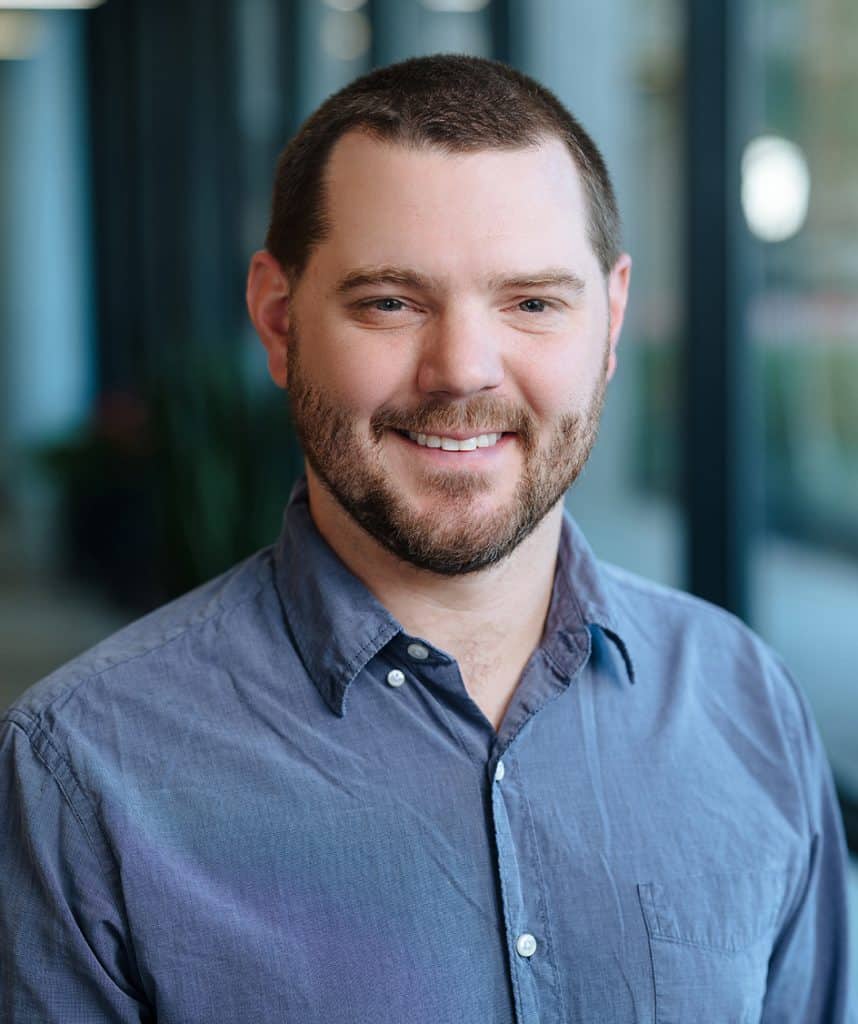
“Give yourself plenty of time to prepare and be patient. Don’t compare yourself to other engineers in your vicinity, everyone is on his or her own timeline. Good luck! – John Chiang, PE
Congratulations on this achievement, everyone!
About the Authors